
12 US states join forces to accuse Trump of unconstitutional tariff policies! The gold market once again faces the dual test of geopolitical policies
- April 25, 2025
- Posted by: Macro Global Markets
- Category: News
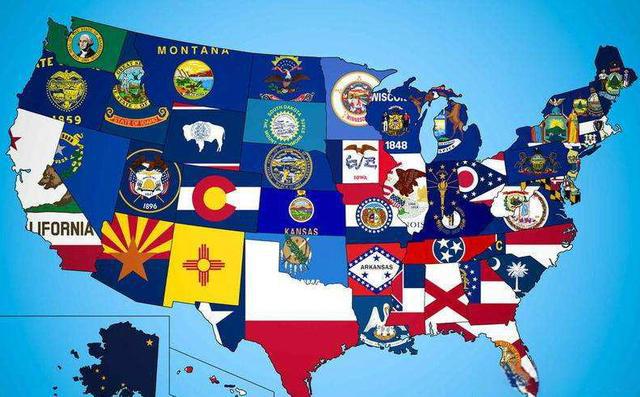
On April 23rd local time, a coalition of 12 states in the United States filed a lawsuit with the New York International Trade Court, accusing the Trump administration’s “reciprocal tariffs” policy of violating the Constitution and requesting the court to rule that the policy is illegal and prevent its implementation. The states involved in the lawsuit include New York, California (previously sued separately), Arizona, and others, covering major economic centers on both the east and west coasts, representing nearly 40% of the US population and 50% of the import trade volume.
The indictment points out that the Trump administration’s use of the International Emergency Economic Powers Act to impose “abnormal and constantly changing tariffs” on imported goods is essentially a “subversion of the constitutional order” – according to Article 1.8 of the US Constitution, the power to set tariffs is exclusive to Congress, and the President can only use emergency powers when faced with “abnormal and special threats”. The plaintiff believes that the current trade environment does not constitute a statutory state of emergency, and the government’s arbitrary tax increases through administrative orders have led to high inflation in the United States (March CPI year-on-year 5.2%), supply chain chaos (automotive industry costs skyrocketing by 18%), and triggered global financial market turbulence.
New York State Attorney General Letitia James bluntly stated, “The President has no authority to levy taxes through social media and executive orders, and this is a blatant violation of Congress’ legislative power.” Arizona Attorney General Chris Myers emphasized, “These crazy tariffs are destroying small and medium-sized businesses, and ultimately American consumers will bear an additional cost of up to $50 billion
White House tough response: Tariff policy is a necessary means to protect American industries
Regarding the lawsuit, White House spokesperson Kush Desai stated at a press conference on the same day that state lawsuits are “political manipulation” and the government “will use all legal means to protect American workers”. He emphasized that the Trump administration’s tariff policies are aimed at addressing “unfair foreign trade practices,” particularly in key areas such as semiconductors and new energy vehicles where “industry dumping” occurs. He also stated that 34 countries have agreed to participate in this week’s tariff negotiations, attempting to reconstruct global trade rules through the principle of “reciprocity.
It is worth noting that this is another collective resistance by local governments in the United States against federal tariff policies, following California’s first lawsuit on April 16, marking the Trump administration’s trade policy has triggered a dual backlash in domestic politics and economy. Members of both parties in Congress have also spoken out simultaneously. The Senate Finance Committee is drafting a bill that requires the President to notify Congress 48 hours before implementing new tariffs, further limiting the expansion of executive power.
The gold market experiences severe volatility: policy uncertainty drives up safe haven demand, while the strengthening of the US dollar suppresses it
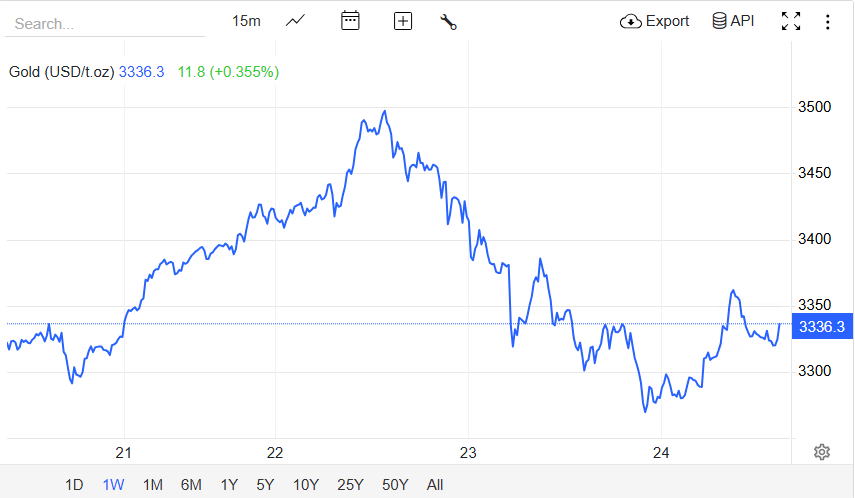
Affected by this event, the international gold market showed a roller coaster trend of “first rising and then falling” on April 23:
Asian session: After the news was exposed, spot gold quickly rose by $12, reaching a high of $3368.45 per ounce, as the market was concerned that the tariff policy stalemate would exacerbate political divisions in the United States and the risk aversion sentiment briefly increased; During the European trading session, as the White House signaled that “tariff negotiations are still progressing,” the US dollar index rebounded to 99.85, while gold fell under pressure and fell to a low of $3313.51 per ounce, with a intraday amplitude of 1.7%.
Institutional viewpoint: Focus on the pace of policy implementation
Goldman Sachs pointed out in its latest report that this joint lawsuit by state governments marks a “concentrated release of legal risks” from Trump’s tariff policies. If a settlement cannot be reached before June, it may lead to the breakdown of global trade negotiations, and gold is expected to break through $3600 in the third quarter. But in the short term, we need to be wary of the impact of US dollar liquidity – CME data shows that the trading volume of tariff related option contracts has surged by 40%, and market concerns about gold volatility (the 1-month VIX Gold Index rose to 28) have intensified.
The joint accusation of the Trump administration by 12 states in the United States is not only a legal lawsuit, but also a direct confrontation between the three tiered system of power and the expansion of executive power in the United States. For gold, the policy uncertainty premium will support prices in the short term, but the final direction of the Fed’s interest rate cuts and global trade restructuring still needs to be observed in the medium term. Investors need to closely monitor the preliminary hearing results of the US International Trade Court on April 26th, which may trigger a new round of intense volatility in the gold market.


 English
  Chinese
  Vietnamese