
The US CPI in April was lower than expected! The expectation of the Federal Reserve cutting interest rates has soared, can gold bulls take advantage of the situation?
- May 15, 2025
- Posted by: Macro Global Markets
- Category: News

The unexpected lower than expected CPI data for April in the United States has sparked strong market expectations for a shift in the Federal Reserve’s monetary policy. Data shows that the CPI in April increased by 2.3% year-on-year, hitting a new low since February 2021, and the core CPI increased by 2.8% year-on-year, which is in line with expectations. As a result, the market is betting that the Federal Reserve may initiate its first rate cut of the year in September, with a full year rate cut of approximately 56 basis points.
1、 Weak inflation data: Market expectations for Federal Reserve policy undergo a major reversal
The data released by the US Bureau of Labor Statistics on May 13th showed that the CPI rose 0.2% month on month in April, lower than the expected 0.3%, and the year-on-year increase further fell from 2.4% in March to 2.3%, hitting a four-year low. The core CPI (excluding food and energy) increased by 0.2% month on month and remained unchanged at 2.8% year-on-year, in line with market expectations. This data breaks the previous market concerns about “sticky inflation”, especially with the significant drop in food prices becoming a key driver – egg prices plummeted by 13% in a single month, the largest drop in 40 years, while bacon, chicken and other prices fell synchronously, lowering the overall inflation level.
Although the 0.3% month on month increase in housing costs and the 0.7% increase in energy prices indicate that structural pressure still exists, the overall weak data has significantly raised market expectations for the Federal Reserve’s interest rate cuts. According to interest rate swap contracts, traders are currently betting that the Federal Reserve will initiate its first rate cut in September, with a cumulative annual rate cut of about 56 basis points, a significant decrease from last week’s 75 basis points. However, the timing of the first rate cut has been moved up from December to September. TD Securities predicts that there may be five interest rate cuts by 2025, believing that a slowdown in economic growth will force the Federal Reserve to adopt loose policies.
2、 Federal Reserve Policy Game: Uncertainty of Interest Rate Reduction Path and Market Reaction
Federal Reserve officials have recently expressed a cautious attitude. On May 12th, Federal Reserve Governor Kugler pointed out that the Trump administration’s tariff policy may push up inflation and drag down economic growth, and even after the easing of trade tensions between China and the United States, it is still necessary to be vigilant about the lagging effects of policy transmission. In his speech late at night on May 14th, Federal Reserve Chairman Powell emphasized that the Fed needs to be patient and maintain high interest rates to ensure that inflation continues to cool down, but made it clear that the next step is unlikely to be a rate hike. Although this statement did not directly mention a rate cut, it sent a signal of policy shift, further consolidating market expectations for a rate cut in September.
Affected by this, the US dollar index plummeted to 101.40 in the short term after the data was released, then rebounded to 101.54, and finally closed at 100.9251, down 0.0544%. The yield of the US 10-year treasury bond bond fell back to 4.429%, a few basis points lower than before the data release, reflecting the weakening of the market’s expectation of sustained inflationary pressure. In terms of the US stock market, the Nasdaq index rose 1.61% and the S&P 500 index rose 0.72%, indicating a significant positive response from risk assets to expectations of interest rate cuts.
3、 Opportunities in the gold market: dual drivers of interest rate cut expectations and geopolitical risks
The weak inflation data and rising expectations of interest rate cuts have injected a shot in the arm into the gold market. On the morning of May 14th in the Asian market, spot gold rose to a recent high of 3257.81. But after the market opened today and fluctuated around 3226, it experienced a short-term correction and rose by $10 to around $3237.37.
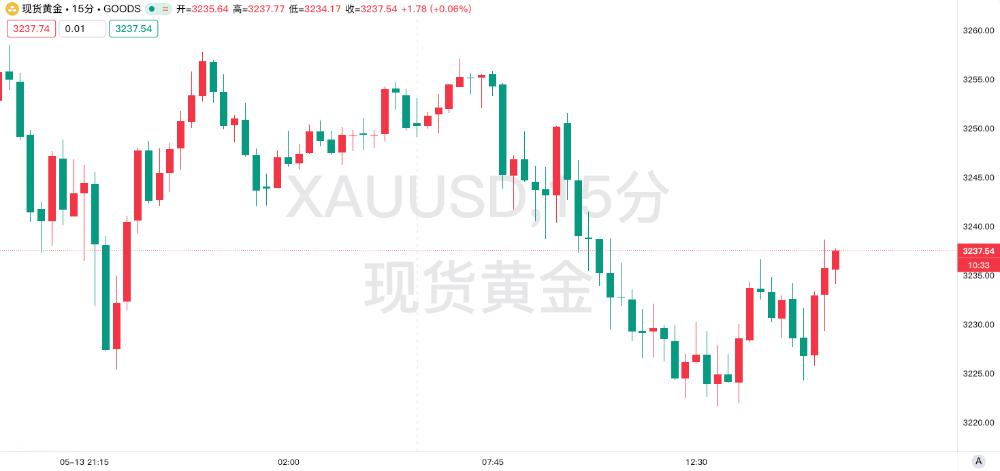
The resurgence of geopolitical risks further strengthens the safe haven nature of gold. The situation in the Middle East has become tense again due to Israel’s airstrikes on Iran’s nuclear facilities, and negotiations between Russia and Ukraine have reached a deadlock. Although the India Pakistan conflict has ceased, there are still hidden dangers, which have driven safe haven funds into the gold market. According to data from the World Gold Council, in the first quarter of 2025, there will be a global inflow of 226 tons of gold ETFs, and the demand in the Chinese market will reach a historic high. Institutional funding layout will continue.
The unexpected weakness in inflation data and the shift in Federal Reserve policy expectations have put the gold market at a critical turning point. The dual driving force of expected interest rate cuts and geopolitical risks provides support for gold prices, but policy uncertainty and the risk of repeated inflation still need to be vigilant. Investors need to closely monitor subsequent data and events to seize opportunities in market fluctuations.





 English
  Chinese
  Vietnamese