
Trump boasts that tariff threat is effective: EU accelerates negotiations, gold market’s long short game intensifies
- May 29, 2025
- Posted by: Macro Global Markets
- Category: News

On May 27th, US President Trump declared on social media that his threat to impose a 50% tariff on the European Union was “effective,” stating that the EU has taken the initiative to accelerate the trade negotiation process. This statement originated from Trump’s sudden escalation of the tariff threat last week, and the President of the European Commission, von der Leyen, made an urgent call for consultation, which ultimately prompted Trump to postpone the implementation of tariffs from June 1 to July 9. However, the market’s concerns about trade frictions have not completely dissipated, and gold prices have shown a fluctuating pattern under the interweaving of long and short factors.
1、 Event Review: Tariff Threat Escalation and EU Compromise
Trump’s Extreme Pressure Strategy
On May 23rd, Trump accused the European Union of “setting trade barriers and manipulating currency” on social media, and announced a 50% tariff on EU goods starting from June 1st, triggering a sharp drop in European and American stock markets. The European Stoxx 50 index fell 2.1% on the day, the German DAX index fell more than 2%, and the futures of the three major US stock indexes all fell more than 1% before trading.
This threat is seen as a continuation of Trump’s “maximum pressure” strategy. Since the United States imposed a 25% tariff on EU steel and aluminum products in March 2025, negotiations between the two sides have remained deadlocked. Trump’s escalation of tariff threats this time aims to force the EU to make concessions in areas such as industrial tariffs and agricultural market access.
Emergency mediation and postponement by the European Union
In the face of Trump’s tough attitude, the President of the European Commission, von der Leyen, took the initiative to call Trump on May 25, promising to “rapidly advance negotiations”. Subsequently, Trump announced that the implementation of tariffs would be postponed to July 9th, consistent with the originally scheduled expiration date of the “equivalent tariffs”.
EU Trade Commissioner Shevchenko will meet with US Trade Representative Grier in Paris on June 4th to discuss tariff issues in key areas such as steel, aluminum, and automobiles. The EU also proposed a revised trade proposal, including mutual reduction of industrial tariffs and increased purchases of US soybeans and liquefied natural gas, but it was previously rejected by the United States.
Trump’s boasting
On May 27th, Trump posted on “Truth Society” stating that “the European Union has called to request a meeting date to be determined as soon as possible, which is a positive signal. He emphasized that if negotiations fail to reach a fair agreement, he will reserve the right to impose tariffs.
2、 Gold market: temporary weakening of short-term safe haven demand
Trump’s decision to postpone the implementation of tariffs has temporarily eased market concerns about an immediate escalation of trade frictions. On May 28th, the US Consumer Confidence Index for May rebounded significantly from 85.7 in April to 98, reaching a three-month high, indicating an increase in economic resilience and the attractiveness of risk assets.
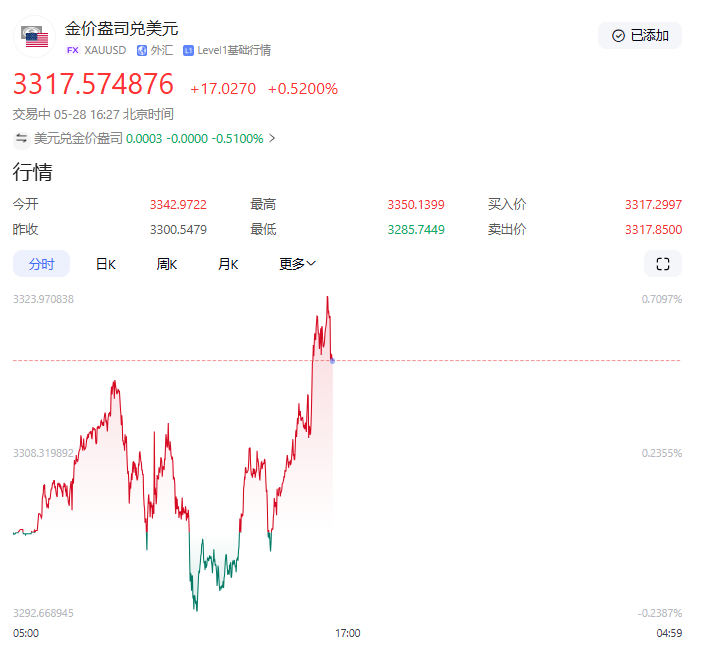
As a result, the short-term safe haven demand for gold has cooled down, falling to the 3300 level yesterday and then experiencing a small pullback today, rising to around $3317 for volatility. However, the market remains wary of the repetitiveness of Trump’s policies – historical data shows that Trump has repeatedly backtracked in trade negotiations, such as delaying the implementation of tariffs on China three times in 2024.
3、 Future outlook: Progress in negotiations
The market needs to closely monitor the progress of the European and American trade negotiations on June 4th. If both sides make breakthroughs in areas such as automobile tariffs and agricultural product exports, it may further boost risk appetite and suppress gold prices; On the contrary, if the negotiations break down, the escalation of trade frictions will drive the rebound of gold prices.
In addition, economic indicators such as the May durable goods orders data (expected to decrease by 6.3% month on month) and the May Richmond Fed Manufacturing Index will be released this week. If the data is weak, it may exacerbate market concerns about an economic recession and support gold safe haven demand.
Trump’s tariff threat and the EU’s compromise game highlight the fragility of the global trade landscape. Although the short-term rebound in market risk appetite has suppressed gold prices, in the long run, the uncertainty of trade frictions, geopolitical risks, and expectations of Fed interest rate cuts still provide solid support for gold. Investors need to closely monitor the progress of negotiations between Europe and the United States and changes in economic data, and flexibly adjust their positions to cope with market fluctuations.




 English
  Chinese
  Vietnamese