
Trump once again criticizes Powell for being ‘stupid and incompetent’! The gold market is facing a long short game
- May 12, 2025
- Posted by: Macro Global Markets
- Category: News
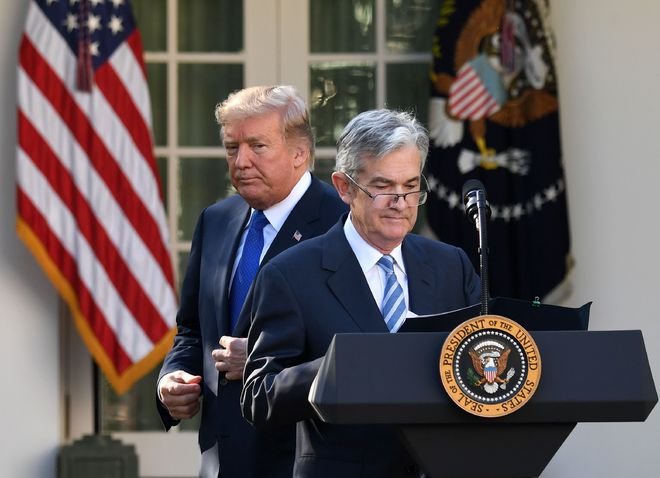
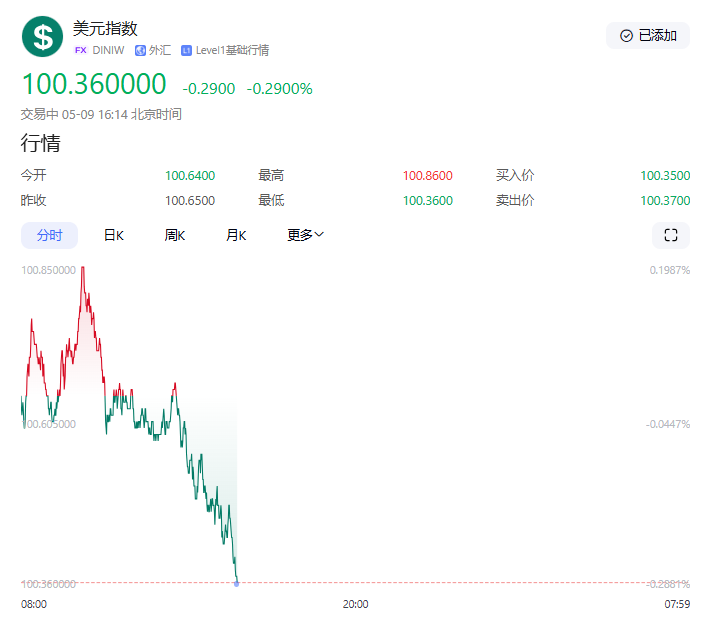
On Thursday (May 9th), US President Trump once again criticized Federal Reserve Chairman Powell on social media, calling him “foolish and incompetent” and accusing the Fed of being “slow to act” and failing to cut interest rates in a timely manner to cope with the downward pressure on the economy. At the same time, the trade agreement framework reached between the United States and the United Kingdom on May 8th sent a signal of easing global trade frictions, with the US dollar index jumping 1.03% to 100.639 on the same day, reaching a new high in nearly a month, further suppressing market expectations of the Federal Reserve cutting interest rates.
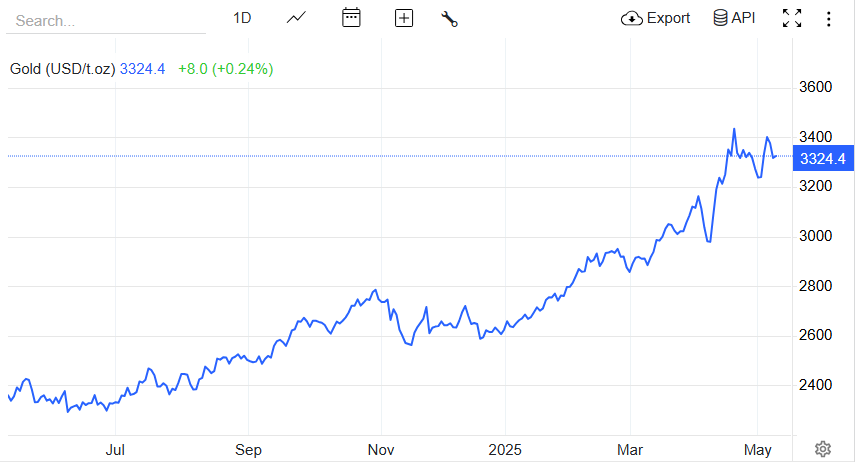
Affected by this, the international gold price fell below $3280 per ounce during the Asian session on May 9th, but then rebounded and fluctuated around $3300. As of press time, the London spot gold price was reported at $3324.4 per ounce, slightly up 0.24% from the previous trading day.
1、 Trump’s’ rate cut tug of war ‘with the Federal Reserve escalates
Trump’s latest remarks are a direct response to the Federal Reserve’s decision to keep interest rates unchanged on May 7th. At the monetary policy meeting on that day, the Federal Reserve maintained the target range for the federal funds rate at 4.25% -4.50% for the third consecutive time and emphasized that “inflationary pressures still need to be observed”. Powell mentioned “tariffs” 20 times at a press conference and stated that “the cost of waiting and observing is quite low,” implying that the Federal Reserve will continue to evaluate the impact of Trump’s tariff policies on the economy.
This stance has completely angered Trump. He called Powell a “fool” on social media and mocked him for “speaking to the wall is more meaningful than communicating with him”. Vice President Vance also strongly supported Trump in a Fox News interview, stating that Powell was “almost wrong in everything” and accusing him of failing to effectively address the economic impact of inflation and trade policies. Analysts point out that Trump’s continued pressure is aimed at diverting public attention from the economic uncertainty caused by his tariff policies and shaping the image of an “economic savior” for the 2026 election.
2、 The US UK trade agreement sends a signal of easing, intensifying the game between the US dollar and gold
The framework of the US UK trade agreement reached on May 8th has become another focus of market attention. According to the agreement, the United States will impose a 10% tariff on the first 100000 cars exported from the United Kingdom, and maintain a 25% tariff on any excess; The UK agreed to expand market access for agricultural products such as beef and ethanol from the United States. Although the details of the agreement still need to be finalized, the market generally believes that this is the first substantial breakthrough of Trump’s “equal tariffs” policy, which may provide a template for subsequent negotiations with economies such as the European Union and Japan.
The US dollar index surged 1.03% on the same day, reaching a new high in nearly a month, but fell back to 100.36 today. The strengthening of the US dollar directly suppressed the attractiveness of gold priced in US dollars, and spot gold plummeted 1.74% on May 8th, falling below the $3300 mark. However, the “limitations” of the agreement have also raised market doubts: the United States has not lifted the 10% benchmark tariff, and UK car exports are still subject to quota restrictions, and the long-term risks of trade frictions have not been completely eliminated.
3、 Market strategy for the future
Trading strategy: For details, please refer to the column “Exclusive Opinion”
Risk Warning: Beware of the Federal Reserve’s “hawkish surprises” (such as CPI exceeding 3.5%), Trump’s repeated tariff policies, and the escalation of conflicts in the Middle East.
The escalating conflict between Trump and the Federal Reserve, as well as the implementation of the US UK trade agreement, have led to a short-term pattern of “strong US dollar, weak gold” in the gold market. However, the long-term existence of central bank gold purchases, expectations of Fed interest rate cuts, and geopolitical risks still provide a “safety cushion” for gold prices. Investors need to closely follow the May 13th US CPI data and Trump’s policy trends, seizing opportunities between the “policy game” and the “safe haven pulse”. In a market environment dominated by uncertainty, the position of gold as the “ultimate safe haven asset” may be further consolidated.



 English
  Chinese
  Vietnamese