
US military reaches ceasefire agreement with Houthis, Trump predicts’ epic news’ to disrupt gold market
- May 8, 2025
- Posted by: Macro Global Markets
- Category: News

1、 Event Focus: US Cease Fire and Trump’s’ Mysterious Forecast ‘Shakes the World
On May 6th local time, US President Trump announced that the United States had reached a ceasefire agreement with the Houthi militants in Yemen and would cease airstrikes on them from that day on. This decision stems from the Houthis’ promise to stop attacking American ships in the Red Sea and the Strait of Mandeb in exchange for the end of a seven week, over $1 billion bombing campaign by the US military. However, the Houthis have made it clear that they will continue military operations against Israel until the blockade of the Gaza Strip is lifted.
Meanwhile, during his meeting with the Canadian Prime Minister on May 6th, Trump hinted that he would release the “most important news in history” within “a few days,” but did not disclose the specific details. The market speculates that this’ mysterious forecast ‘may involve major diplomatic breakthroughs, domestic policy adjustments, or economic stimulus plans, attracting high attention from global investors.
2、 Middle East situation turning point: the front and back of the ceasefire agreement
The core motivation for reaching the agreement
The Houthi armed forces launched drone and missile attacks on Red Sea shipping, forcing the United States to balance military pressure and economic costs. During the seven week air raid, Houthi militants shot down at least seven US drones, demonstrating their resilience.
Oman, as a mediator, facilitated an agreement between the two parties aimed at maintaining the safety of the Red Sea waterway and paving the way for subsequent Iranian nuclear negotiations. The United States and Iran have conducted three rounds of nuclear negotiations, and a ceasefire may create conditions for the fourth round of negotiations.
Limitations and risks of the agreement
The Houthis only promised to stop attacking American ships, and their attacks on Israel and associated ships will continue. Israel is not aware of the agreement and the Prime Minister’s Office stated that it will “reserve the right to self-defense”.
On May 6th local time in Yemen, Israel launched airstrikes on targets such as Sana’a International Airport, resulting in three deaths. Houthi militants vowed “destructive retaliation” and the ceasefire agreement is facing a test.
3、 Gold market volatility: ceasefire cooling and forecast game
Short term fluctuations: Risk aversion sentiment recedes
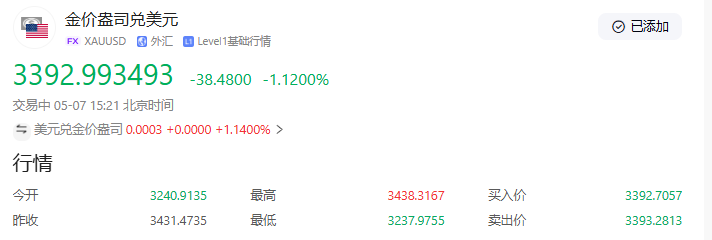
On the morning of May 7th in the Asian market, spot gold plunged $50 from its overnight high of $3434.74 per ounce, hitting a low of $3377, a decrease of 1.5%. The trading volume of COMEX gold futures main contract surged by 200%, indicating an intensification of long short divergence. On a technical level, gold prices have fallen below the 5-day moving average ($3395), but still hold onto the 20 day moving average ($3360), with short-term support moving down to $3350.
Medium – to long-term support: geopolitical and policy risks still exist
Federal Reserve policy: Market expectations for interest rate cuts within the year are heating up (probability 97.2%). If Powell sends a dovish signal at the May FOMC meeting, it may weaken the US dollar and support gold prices; Central bank gold purchases: According to data from the World Gold Council, the global net gold purchases by central banks reached 220 tons in the first quarter of 2025, with China and India continuing to increase their holdings, providing structural support for gold prices; Inflation pressure: The US CPI in April was 3.0% year-on-year. If the data exceeds expectations, it may strengthen the demand for gold to resist inflation.
The current gold market is at a critical juncture of easing geopolitical risks and policy uncertainty. The US military ceasefire will weaken the demand for safe haven in the short term, but Trump’s “mysterious forecast” and Federal Reserve policy expectations still provide potential support for gold prices. Investors need to maintain flexible strategies, adjust their positions based on real-time events, and avoid chasing gains and selling losses.





 English
  Chinese
  Vietnamese